
Knee Dislocaters… UNITE!
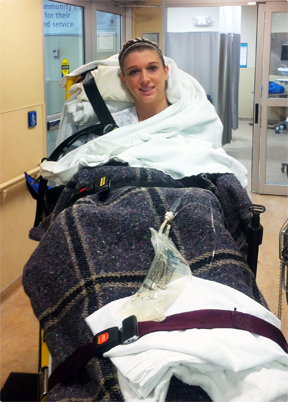 I spent a lot of time researching patellar dislocations; to learn what exactly happened, the chances of it happening again, what I can expect during the recovery process, and more. Some questions I couldn’t find answers to, so I am dedicating this post to all my fellow knee-dislocaters (past and future), who may be also surfing the Internet for answers.
What exactly happened?
The patella (knee cap) is the only bone in the body that isn’t directly attached to other bones. Instead, it is suspended between the quad muscle and patellar ligament. And the stability of the knee cap greatly depends upon the strength of the quad muscle holding it in place. That is why, one of the problems that plagues a child with muscular dystrophy is knee dislocations– their quad muscle is deteriorating, and their knees will begin dislocate even without any trauma administered to them.
For me, I feel as though my quad muscles were the strongest they’ve ever been in my life; but the trauma to my leg occurred while my quad muscle was relaxed and not really being used. A relaxed quad and a twist to the leg was enough to dislocate my knee.
And for me, my “Q Angle” is extreme. This is the degree/angle at which my quad muscle and ligaments are attached to my knee cap. For most humans, it should be 7 degrees (I think?). Mine was 20-something. So, I was ‘constructed’ in a way that makes me an ideal candidate for knee dislocations. Yay!
If you’ve dislocated your knee in the past, you have close to a 50% chance of dislocating it again. Women are also more susceptible to dislocations.
How long do I have to wear a knee stabilizer for?
From the day of my injury, my “straight leg” knee stabilizer was my closest friend for 3 weeks.
I was then moved into a patellar stabilizing “J” brace, which gave my leg flexibility to bend, but had a bumper that kept my knee cap in place. This stayed on 24/7 for a month, but was convenient because it could fit under my clothes (well, yoga pants), and I could walk like a normal person (for the most part).
When can I drive?
This was the hardest for me, since I dislocated the knee on my driving leg. I lost all independence, and am thankful I don’t have kids yet and only had to worry about myself. I was unable to drive for 3 weeks, and I feel as though my recovery was a quick one (because I did my assigned exercises religiously).
I believe if I had dislocated my left knee, I would have been driving after a week (once I was allowed to take the knee stabilizer off when sitting).
How long will physical therapy be?
I’m still in physical therapy now. I started in the beginning of April, and have had 7 sessions so far (averaging 2 sessions per week)… and I will be asking for more, since I just started walking up and down stairs. I won’t be dancing any time soon!
My timeline:
February 11th:
- Dislocated Knee.
- Kept leg in knee brace, elevated at all times, and icing 20 minutes on and off. They recommended to do this for the first 24 – 48 hours. I did it for about 4 days, which dramatically helped the swelling. I used this same strategy when I got my wisdom teeth removed, and it worked beautifully!
February 16th (5 days after “the event”):
- Met with an Orthopedic Surgeon who instructed me to continue to keep my knee stabilizer on when I am sleeping (in case I wake up abruptly or forget about my knee and damage it sleeping) and while in transit. Any other time, I was allowed to take the knee stabilizer off.
- I was given basic leg exercises (left lifts and heal slides) to begin doing twice a day in order to keep some of my muscle and begin increasing flexibility of my knee again.
- Lastly, I was allowed to put weight on my leg (with the stabilizer on), and when it seemed doable, I could begin walking with one crutch, and then no crutches (Again, while leaving my knee stabilizer on).
March 1st:
- Had a follow-up appointment with the Orthopedic Surgeon.
- Removed knee stabilizer, and transitioned into a patellar stabilizing “J” brace.
- Given more advanced leg exercises (different variations of leg lifts with ankle weights) to do for a month, and was allowed to eventually walk without crutches as long as I kept the brace on.
- After injury, it is important to begin basic leg lifts, to help prevent the quad muscle from losing its strength. [You’ll notice that quickly after an accident, your leg is much smaller than your other leg… all because of muscle mass that is lost from the injured leg not getting worked adequately.]
- I can drive as long as I have my patellar stabilizing “J” brace on.
- I didn’t need physical therapy at that time, but was told after the month I would most likely have to go (I assume to learn to walk up and down stairs again, run, … more ‘advanced’ activities with weight-bearing and impact).
March 29th:
Had a follow-up appointment with the Orthopedic Surgeon. Made a lot of progress, but wasn’t allowed to ditch the brace or crutch just yet. Was given a prescription for 8 physical therapy sessions.
April:
Began physical therapy sessions – 2 per week.
May 1:
Follow-up appointment with the Orthopedic Surgeon, and got one more month of physical therapy. I learned that I no longer need to see my surgeon anymore, but he advised me of activities I should try not to do:
- Bear crawls
- Box jumps
- Spider push-ups
- Squat Thrust/Burpee (what I dislocated my knee doing)
May sometime:
Finished physical therapy and was sad to leave. They said I was crazy because I thought it was fun 🙂


 Tea Time with Lindsay